BCBA Continuing Education from Parenting with ABA
For behavior analysts providing parent support services
Caregiver buy in is a skill you CAN build.
And when you build it, sessions get easier, follow-through improves, and progress actually carries over at home.
Parent training is one of the most important parts of our work as behavior analysts—and one of the most complex.
If you’ve ever struggled with caregiver follow-through, resistance, or uncertainty about how to adapt plans without compromising ethics, you’re not alone.
Parenting with ABA Continuing Education provides ACE-approved CE credits specifically focused on how to support parents and caregivers with compassion, clarity, and confidence- using the science of behavior and relationship-centered practice.
Managing or Growing a Clinical Team?
If you're a clinical director or practice owner, this page is written for your BCBAs. We built something specifically for you.
Equip your whole clinical team with ACE-approved parent training CE, one flat price, no per-person invoices to chase down.
You’re Not Bad at Parent Training
You just weren’t trained for it.
Most BCBAs receive little to no formal instruction on compassionate caregiver support during graduate school or supervision (Taylor, LeBlanc, & Nosik, 2019).
This gap often shows up as:
Struggling with caregiver buy-in
Plans that don't generalize
Sessions that feel draining
Tension between best practice and real life
This isn’t a personal failure.
It’s a training gap- and it deserves a better solution.
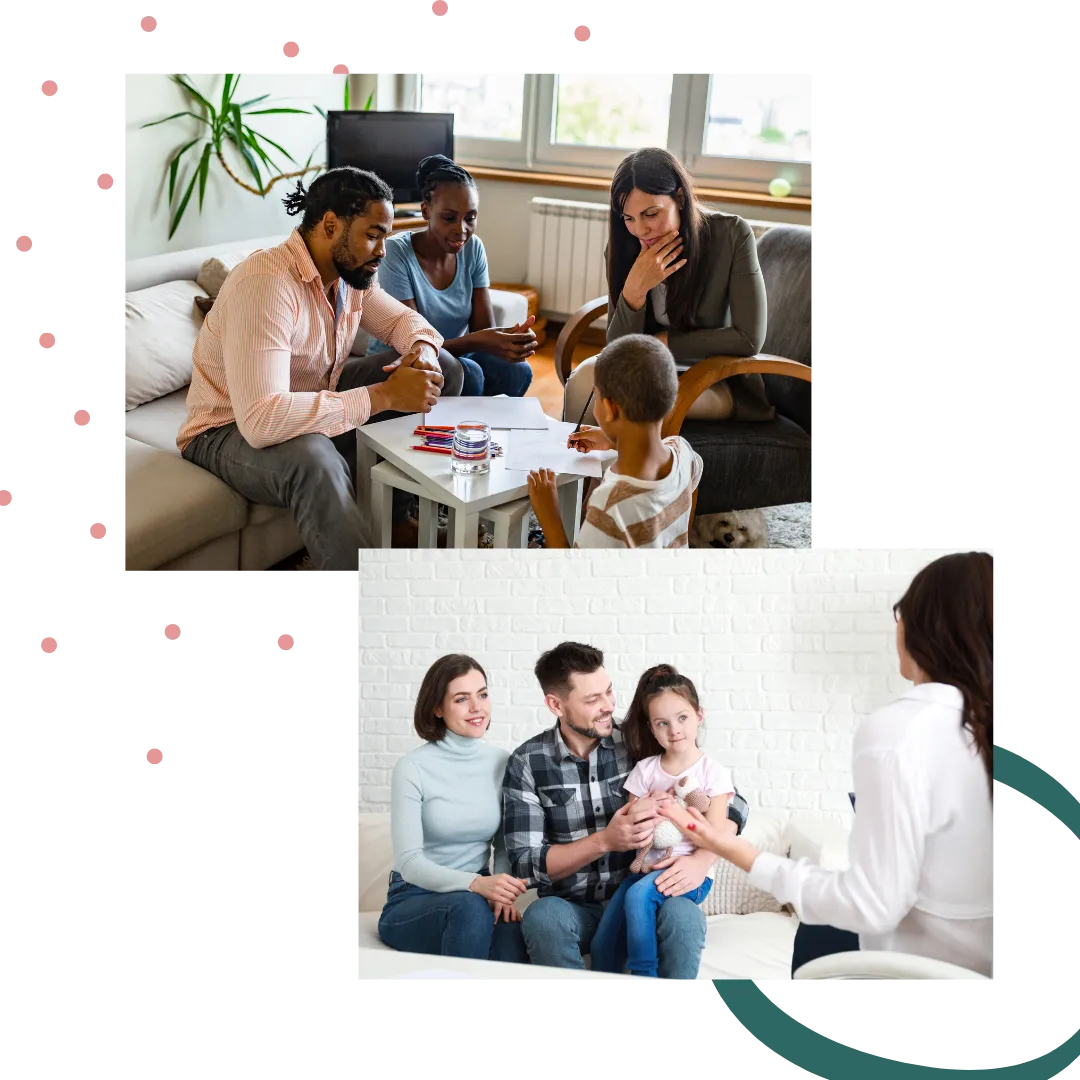
Here for you.
ABA parent training is a clinical skill.
Not an add-on. Not a soft skill. Not intuition.
Effective caregiver support requires:
Compassionate, parent-friendly communication
Flexibility without losing clinical integrity
Collaboration instead of compliance
Effective behavior-change strategies
Strong therapeutic relationships
These skills can be taught, practiced, and strengthened—just like any other clinical competency.
That's why behavior analysts need:
Parenting with ABA Continuing Education
Founded by Parenting with ABA and led by BCBA and author of Parenting with Science, this continuing education experience was created to fill the exact gap behavior analysts keep running into.
This is not generic CE content. It's a place to get support when you need it.
It’s specialized training for BCBAs who want:
Better caregiver buy-in
Stronger collaboration
Less burnout around parent training
Tools they can use immediately
To communicate more effectively with caregivers

Why Continuing Education from Parenting with ABA?

What makes this different
Compassion-first, evidence-based frameworks
Real clinical scenarios you recognize
Live, interactive CEU events- not just passive, boring videos
Ongoing support, not one-and-done learning
Monthly Coffee Talk virtual meetups for connection, support, and a chance to get your questions answered

What you'll walk away with
More confident parent conversations
Increased caregiver follow-through
Tools to strengthen caregiver collaboration and follow-through
Clearer decision-making for parent support
Next Month’s Live CE Event
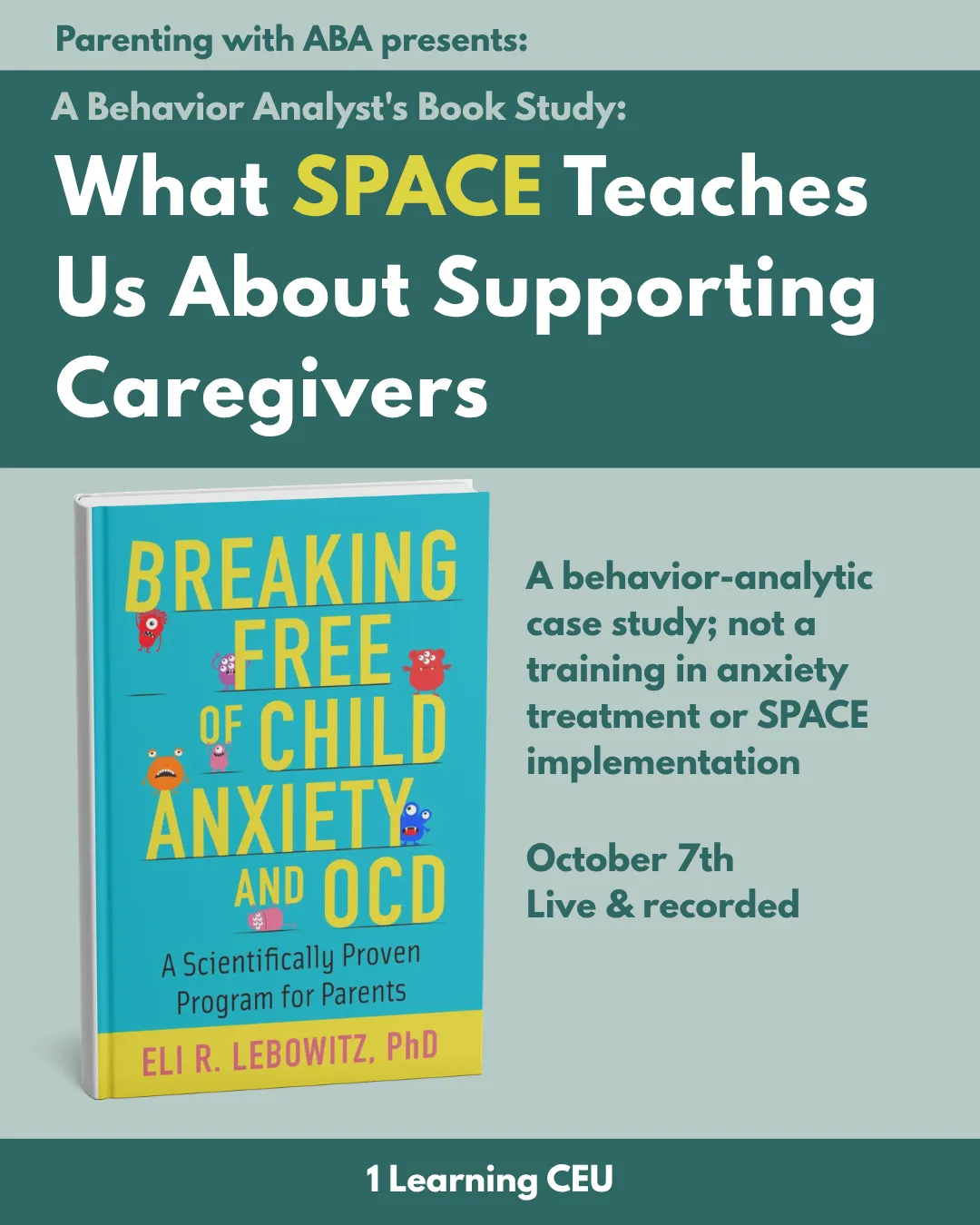
What SPACE Teaches Us About Supporting Caregivers:
A Behavior Analyst's Book Study
Included with Membership | Live + Recorded | 1 ACE-Approved CE
Every time you coach a caregiver to help a child avoid distress, you're making a reinforcement decision - whether anyone's named it that way or not.
This book study takes Breaking Free of Child Anxiety and OCD, a well-documented, parent-mediated program from outside ABA, and uses it as a case study to put precise language to what you're already doing: negative reinforcement, shaping, the mediator model, and what "supportive" caregiver coaching actually means.
Not a new intervention to learn; a sharper lens for the one you already have.
📅 Event Details
Learning objectives
Topic: What SPACE Teaches Us About Supporting Caregivers:
A Behavior Analyst's Book Study
Speaker: Leanne Page, BCBA-LBA
Date: October 7th
Time: 11am eastern
(and recording goes out after to all registrants)
1 BACB LEARNING CEU
In this session, participants will learn to:
Explain the mediator model of behavior change and identify at least one parallel between it and ABA's own parent-training literature.
Compare supportive parenting as described in SPACE to supportive caregiver coaching as described in ABA's compassionate-care research.
Identify how negative reinforcement can keep both a child's avoidance behavior and a parent's accommodating behavior going, using a real-world parent-training program as the example.
Explain the logic behind sequencing behavior change targets from easiest to hardest, connecting a caregiver-coaching hierarchy to shaping and response-hierarchy principles already used in ABA treatment planning.
Course abstract
BCBAs regularly coach caregivers through a child's avoidance and accommodation patterns - refusing situations, seeking constant reassurance, routines built around avoiding distress - even when anxiety itself isn't the identified treatment target.
This session uses Breaking Free of Child Anxiety and OCD (Lebowitz, 2021) and SPACE (Supportive Parenting for Anxious Childhood Emotions), a parent-mediated program developed at the Yale Child Study Center, as a case study for identifying behavior-analytic principles already within a BCBA's scope of practice: how negative reinforcement can maintain both a child's avoidance and a parent's accommodating behavior, how sequencing behavior change targets from easiest to hardest reflects shaping and response-hierarchy principles already used in ABA treatment planning, and how the mediator model underlying SPACE parallels ABA's own parent-training literature.
Attendees will also compare how SPACE describes supportive parenting to how ABA's compassionate-care research describes a supportive caregiver relationship.
This session is not a training in SPACE, anxiety treatment, or psychotherapy - attendees will leave with a sharper behavior-analytic lens for a pattern they already see in their caseloads, illustrated through a well-documented example from outside the field.
What this session is:
A behavior-analytic case study. Attendees will examine a published, parent-mediated intervention from outside the field of ABA and identify the behavior-analytic principles operating within it - reinforcement contingencies, extinction, differential reinforcement, generalization, and the mediator model of behavior change - with the goal of sharpening how BCBAs recognize and apply these same principles in their own caregiver training and ABA treatment planning.
What this session is not:
This session does not train attendees to implement SPACE, diagnose or treat anxiety or OCD, or provide any form of psychotherapy. It does not qualify attendees to deliver SPACE or any anxiety-specific intervention. Anxiety and family accommodation are discussed only as the applied example through which core ABA principles are illustrated - the clinical content itself remains outside the scope of behavior analysis and outside the scope of this session.
Recording access never expires. CE credit available for live and recorded participation.
All past CE topics availabe to members in the CE library.
Inside the Continuing Education Library
You’re not just getting CE credits.
You’re getting a place to go when you’re stuck in a parent session and thinking,
“What do I actually do here?”
Inside the membership, you’ll find a full library of parent training–focused CEUs- organized around the exact challenges behavior analysts run into every day.
Not sure where to start? Start here:
Pick a pathway based on what’s happening in your sessions right now.
Start Here: Parent Training Foundations
The Behavior Analyst’s Role in Parent Training
Making Parent Training Work
Antecedents in Action: Teaching Caregivers
Deliver Effective Instructions
Compassionate Care & Connection
Defining Compassionate Care
The Therapeutic Relationship in ABA
Creating Collaborative Relationships in ABA Parent Support
Self- Compassion and Behavior Analysis
Caregiver Buy-In & Follow-Through
Building Buy-In: Strategies for Caregiver Collaboration
How to Talk so Caregivers Listen
When Caregivers Aren’t Following Through
Practical Strategies You Can Use This Week
Structured Solutions
Family Meetings
Troubleshooting Token Systems
ACT & Values-Based Parent Training
Values-Based Parent Training
Acceptance & Defusion in Practice
Present Moment & Self Regulation
Expert Guest Speaker Series
The Power of Joint Attention with Rose Griffin
Five Strategies: Waitlist to Welcome with Morgan van Diepen
Empower Parents to Engage with Dr. Shelby Dorsey
There’s a training for the exact situation you’re in- without having to figure it out on your own.
Most members don’t join for one CE.
They join because parent training isn’t a one-time problem.
It’s different caregivers
Facing different challenges
Engaging in different conversations- every week
One CE might help today.
But the membership gives you a place to go every time something new comes up.
Choose the option that fits your needs
Monthly CE Membership
Full access to the parent training CE library + all future monthly trainings
Annual CE Membership
Same full access as monthly membership
Get two months free!
Single CEU events
NO subscription required
Only signup for the topics you are interested in
Team Memberships
Equip your whole clinical team, one flat price, up to 45% off per seat
What others are saying
"The events from Parenting with ABA are excellent, both in content and presentation!"
-Behavior Analyst

"This information is needed in the world of ABA."
"I'm learning about parent training strategies in more depth than other CEUS."
- Behavior Analyst
"These are, undeniably, my FAVORITE CE events to attend!"
"I ALWAYS walk away with a small thing to change/adjust/improve/add and that makes all the difference to me!"
- Behavior Analyst
"Super applicable topics with a snap shot of literature plus tangible strategies to improve service delivery! Also, the group interaction piece feels like it holds me accountable for participating or catching the recording within a timely manner - aka keeping a slow and steady rate of CEU acquisition vs. grinding it out last minute!"
-Behavior Analyst
"It is one of the coolest platforms to have available to openly discuss different topics, live with others in the field."
- Behavior Analyst
"I love the practical ways to implement, this is something lacking in most CEs."
"Super practical, while still connected to literature - and fun too!"
- Behavior Analyst
Frequently Asked Question
General Questions
Is this CE approved for BCBAs?
Yes. Eligible sessions are ACE-approved and count toward BCBA continuing education requirements through the Behavior Analyst Certification Board (BACB®). CE credit is available for both live sessions and recordings, when applicable.
How is this different from other BCBA continuing education courses?
Most CE focuses on procedures and protocols; research that is not directly applicable to your everday job.
Parenting with ABA Continuing Education focuses on caregiver buy-in, collaboration, and compassionate communication- the part of the job most BCBAs were never formally trained for.
This is practical, relationship-driven training for real parent support challenges.
Will this actually help with caregiver buy-in?
Yes. That’s the core focus.
You’ll learn:
How to reduce resistance and defensiveness
How to use parent-safe, collaborative language
How to adapt plans without compromising ethics
How to improve follow-through without pressure
Many members report feeling more confident and less drained in parent sessions.
Are the sessions live or recorded?
Both.
Live sessions are offered regularly
Recordings are sent afterward
Recording access does not expire
CE credit is available for live and recorded participation (when applicable)
Designed to fit real clinical schedules.
Do I need a membership to participate?
No.
You can choose:
A monthly membership for ongoing CE and support
Single CE events with no subscription
Annual option for deeper resources and best value
You can select what fits your needs right now.
How do I know where to start in the library?
You don’t have to figure it out. Inside the membership, the library is organized by common parent training challenges, so you can choose a starting point based on what’s happening in your sessions right now.

Meet the behavior analyst behind Parenting with ABA
Leanne Page, BCBA- LBA
Hi, I’m Leanne Page, BCBA, continuing education instructor, and the founder of Parenting with ABA.
I created this training because I’ve seen how powerful good caregiver support can be. And I’ve also seen how often behavior analysts are expected to do parent training without ever being formally taught how.
As a behavior analyst, parent coach, and author of Parenting with Science, I’ve spent years working directly with families and listening to hundreds of BCBAs talk about the same challenges:
Struggling with caregiver buy-in
Feeling stuck between best practice and real-life capacity
Wanting to be compassionate and effective
Feeling frustrated that parent support feels harder than it should
The truth is, most of us were trained extensively in behavior change for children—but not for adults. Especially adults who are stressed, overwhelmed, and doing their best.
Parenting with ABA Continuing Education exists to bridge that gap. You don’t have to figure this part of the job out alone. And you deserve training that reflects the real work you’re doing.

As seen in:
Monthly or Annual CE Membership Signup
Scroll down for single CE order form
Single CE Option Signup Below
Want to only attend for this month's live topic?
Use the form below for single CE event registration only.
Helping you help families.
You Don’t Have to Keep Guessing With Parent Support
Start with one training. Use it this week. Then come back when you need the next step.
You care deeply about families.
You want your recommendations to work in real life.
And you deserve training that reflects the reality of your role.
Get the support you should have received in training- and start enjoying parent support again.